With demand for quality housing increasing, attention is frequently being paid to the role brownfield land can play in resolving the housebuilding crisis. But what about contaminated land risks? And how can environment monitoring help? Read on…
According to the CPRE’s “State of Brownfield Report”, a large proportion of England’s housing need could be met using brownfield land that has planning permission, without the need to encroach on undeveloped greenfield or Green Belt land. A conservative calculation suggests that there is enough brownfield land to build 1.41 million homes in England. Of those, more than half (55%) already have planning permission.
What is brownfield land?
Brownfield land is defined as previously developed land, meaning that it is or was previously occupied by a permanent structure. This could include past industrial, commercial or waste activities, which is where the challenges arise. While brownfield sites present the opportunity to build the new housing the UK so desperately needs, they can present a challenge to landholders, developers and contractors, with the ground commonly impacted by its previous use. This can include anything from contaminated soil to land stability issues.
Where there are concerns over contaminated land, before any new development can proceed the soil must first be assessed and, where required, mitigated.
What is the role of environmental monitoring?
Carrying out excavations or disturbing the ground on brownfield land, whether for treating the existing soil or digging foundations for new housing, carries with it the risk of contamination caused by waste material or residue from the previous structure. Once excavated, these contaminants can be released back into the air. To make matters worse, Volatile Organic Compounds (VOCs) are invisible to the naked eye and can even be odourless, making them difficult to detect without specialist equipment. There are other factors to consider too, including noise and dust.
To ensure compliance with the relevant building and environmental standards, monitoring systems can be essential, with the innovative sensors able to provide instant and live insight into a site and its conditions.
Enviroguard is a bespoke, all-in-one environmental solution capable of monitoring either a single factor or multiple simultaneously. Fully installed and configured by our expert engineers, depending on your individual requirements, it can measure noise, dust, vibration, VOCs, wind speed, wind direction and water quality all from the one unit.
Monitoring in action
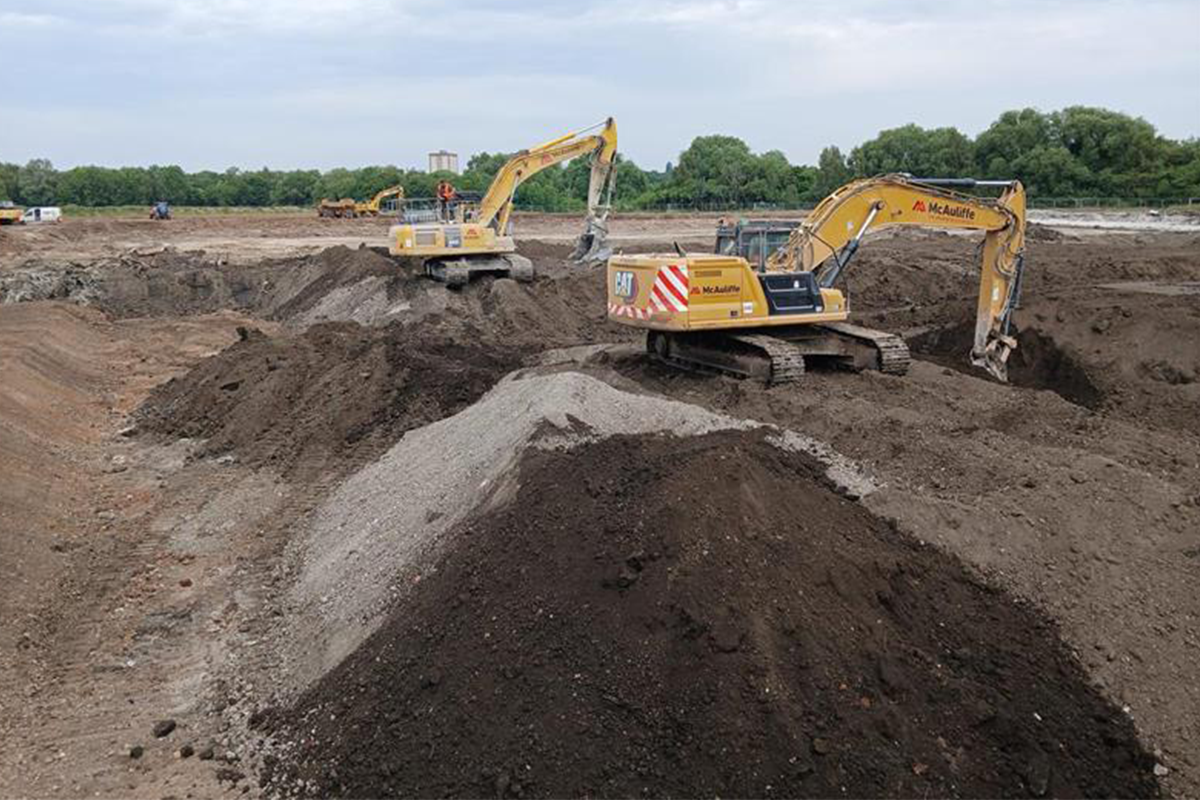
One of the UK’s largest brownfield remediation and enabling works contractors recently made use of our specialist environmental monitoring services during a major development project in the Midlands, facilitating the safe construction of new homes.
McAuliffe was tasked with carrying out a comprehensive programme of complex soil remediation and the re-engineering of soils in-situ, ready for the site’s redevelopment. The need to disturb the ground raised concerns around the risk of contamination including VOCs being released, as well as noise, dust and other issues requiring continuous monitoring.
The remediation contract has seen a total volume of approx. 90,000m3 successfully treated, with no significant impact to the surrounding environment.
Speaking about the project, McAuliffe’s Senior Remediation Engineer, Dan Farr, commented: “This has been a complex remediation job requiring environmental permits along with strict monitoring. We were concerned about noise, vibration and the potential release of VOCs because of these works, as well as odours escaping into the atmosphere, which is why we called in Mabey Hire. We have worked with the team on previous remediation schemes, though this was the first large scale project where we opted to have the automatic reporting via Mabey Hire’s Insite portal.”
The bespoke monitoring system comprised five Enviroguard monitoring stations – all powered by solar panels – with three calibrated to detect noise, dust and vibration while the other two also incorporated VOC monitoring with NH3 detection, plus a weather statin to help understand gas dispersion and environmental conditions on site.
Dan Farr reflected on the outcome saying: “The Enviroguard units helped fulfil our commitments under the environmental permits, but the other main attraction for us was the ability to make the reporting process truly automated.
“All data from the different units was uploaded onto the portal 24/7, with any alerts emailed to the project team, and then it generated weekly reports every Friday, which we could easily relay to the consultants and the Environment Agency. All the data remains readily available and will all go into our final report.”