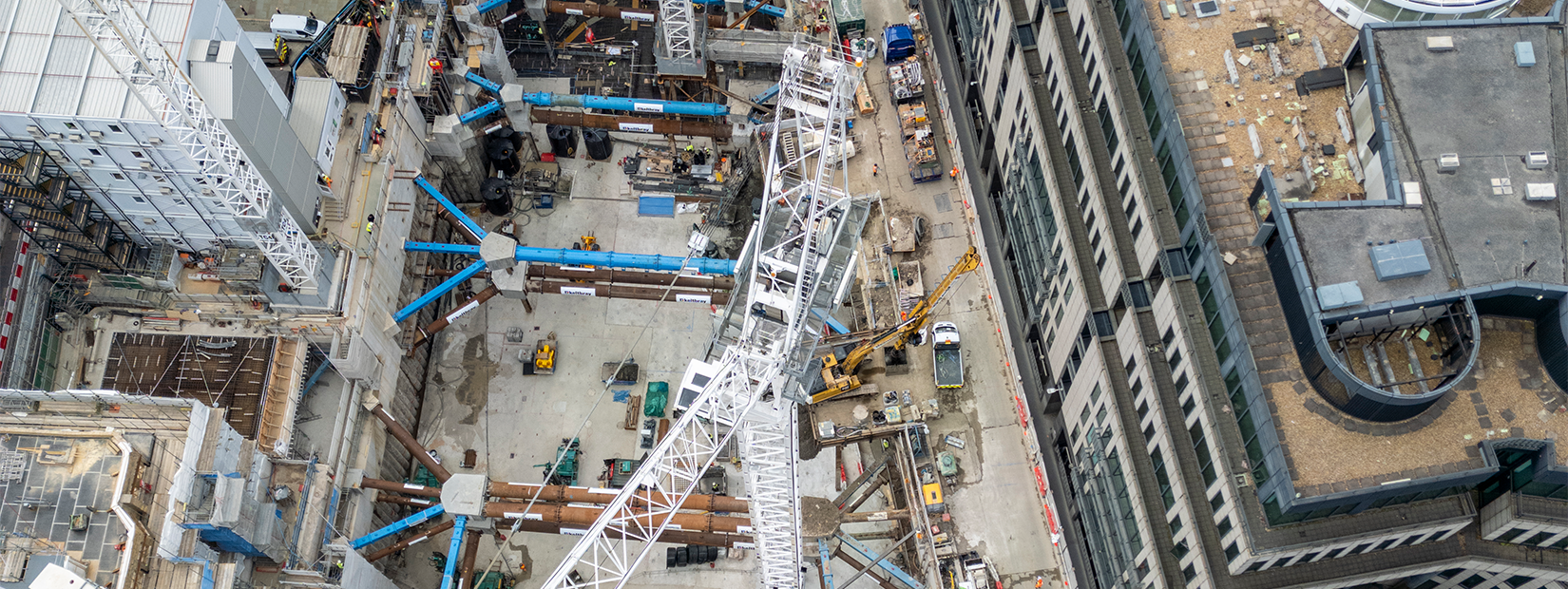
With the UK’s updated infrastructure pipeline now covering 734 planned projects and £718 billion of public and private investment expected over the next decade, the margin for error on major projects is tightening. Here, Matt Westhead, Engineering Director – Major Projects at Mabey Hire, explores five common risks that can go unnoticed on complex construction schemes, and why early engagement with temporary works specialists can help contractors and engineers maintain control of time, cost and safety.
The National Infrastructure and Service Transformation Authority’s (NISTA) updated UK Infrastructure Pipeline points to sustained activity across hospitals, schools, railways, reservoirs, clean energy and other nationally significant schemes. For contractors, this represents major opportunity, but delivery will depend on more than capacity alone, calling for disciplined planning, clear interfaces and early risk reduction.
Alongside well-known pressures such as material availability, labour shortages and economic volatility, major projects can often be affected by less visible but equally damaging risks. Poor collaboration, late design changes, environmental constraints, restricted access and possession overruns may not attract headlines, but all have the potential to undermine programme certainty, increase cost and compromise safety.
For contractors and engineers, the answer lies in identifying these risks before they materialise on site. This is where temporary works can have a key role to play, not treated as a secondary consideration that follows the permanent design but instead planned early and coordinated properly. Here, temporary works can provide the control, visibility and constructability needed to keep complex projects moving safely and efficiently.
1) Clashes between the permanent and the temporary works
Rework remains one of construction’s most persistent, and avoidable, costs. Research from the Get It Right Initiative (GIRI) highlights the direct cost of avoidable error at around 5% of project value, well above the UK’s average profit levels and costing approximately £5 billion per year.
On major projects, causes can be numerous, ranging from incomplete information and poor communication to interface gaps or clashes that are not easily identified in 2D drawings. Where existing structures, new permanent works and the temporary works meet, an unresolved clash can quickly become a costly redesign once construction is underway.
The fix starts with timing. Early contractor involvement and early input from temporary works designers and coordinators allow the permanent and temporary to be considered as one integrated system. This makes it easier to visualise interfaces and help teams identify any potential problem areas before they reach site.
Immersive visualisation tools can push this further, allowing for a digital rehearsal of the works before any equipment even reaches site. For example, our EVE platform enables project teams to explore proposed temporary works schemes, including project phasing, access and sequencing, so that risks can be challenged earlier.
2) Exceeding environmental or structural constraints
Dust, noise and vibrations are expected on major construction sites. However, the risk arises when these impacts exceed agreed thresholds, prompting complaints, enforcement action or even a pause in activity while mitigation measures are reviewed and implemented.
With this in mind, environmental monitoring is becoming an increasingly important part of temporary works planning. Carefully calibrated sensors, live data dashboards and agreed trigger levels can alert project teams before limits are breached, allowing them to take proactive action rather than responding after the event. This supports compliance with local requirements and relevant controls, including Section 61 prior consent process under the Control of Pollution Act 1974 where applicable.
The same principle applies to structural monitoring. Vibration from excavations, piling, demolition or adjacent works can all affect neighbouring buildings, utilities and infrastructure. Real-time monitoring of movement, vibration and load can provide an early warning system, helping teams to demonstrate that risk controls are working as intended.
3) Working in tight or live environments
Site context matters, determining whether a temporary works solution succeeds in practice. A large basement excavation in central London and a temporary bridge lift in a residential area may require very different approaches, but both can be shaped by restricted access, surrounding buildings, traffic management and live infrastructure.
This is where adaptability can be essential. Modular equipment that can be transported in sections and assembled on site can offer valuable flexibility, without compromising capacity. Equally important is the experience behind the installation. A temporary works partner with in-house site teams can bring practical insight into the design process, helping to ensure that what is drawn is genuinely buildable within the constraints of the project.
4) Last minute design changes
Few designs remain unchanged through to construction. Ground conditions may differ from assumptions, a client requirement may shift or a permanent works detail could be revised after temporary works equipment has already been ordered. When this happens late, pressure quickly passes to the supply chain to respond without disrupting the programme.
Managing this risk is not about eliminating change but instead building enough flexibility into the process to absorb it. That means working with specialists who can turn around revised designs quickly, provide access to versatile equipment stock and communicate directly with site teams. A late change is far easier to manage when a temporary works partner is embedded early enough to understand the design intent.
5) Time constraints and costly possession periods
On highway and rail projects, time is often critical. Possession periods – whether overnight, across a weekend or during a bank holiday – are tightly controlled. Overruns can carry significant operational and financial consequences.
In this environment, reliability matters. Project teams need temporary works equipment, design support, delivery logistics and installation planning that align with the wider programme. Collaboration truly is key. When temporary works partners, contractors, designers and site teams operate as one team rather than in silos, there is less risk of miscommunication turning a tight possession period into a missed one.
Engineering support and depot coverage also have a practical role to play. A supplier with a strong UK depot network can help keep equipment close to site, reducing logistics risks when timescales leave no room for error.
Bringing the permanent and the temporary together
None of these risks are new to the industry. What is changing is the recognition that temporary works can play a more strategic role in managing them. When temporary works are considered early, coordinated with the permanent design and supported by experienced teams, they can help bring clarity to complex and demanding programmes.
For major projects, early engagement is not simply a procurement preference. It is a practical way to reduce avoidable error, improve constructability and give project teams greater confidence that what is planned can be delivered safely, efficiently and on time.